
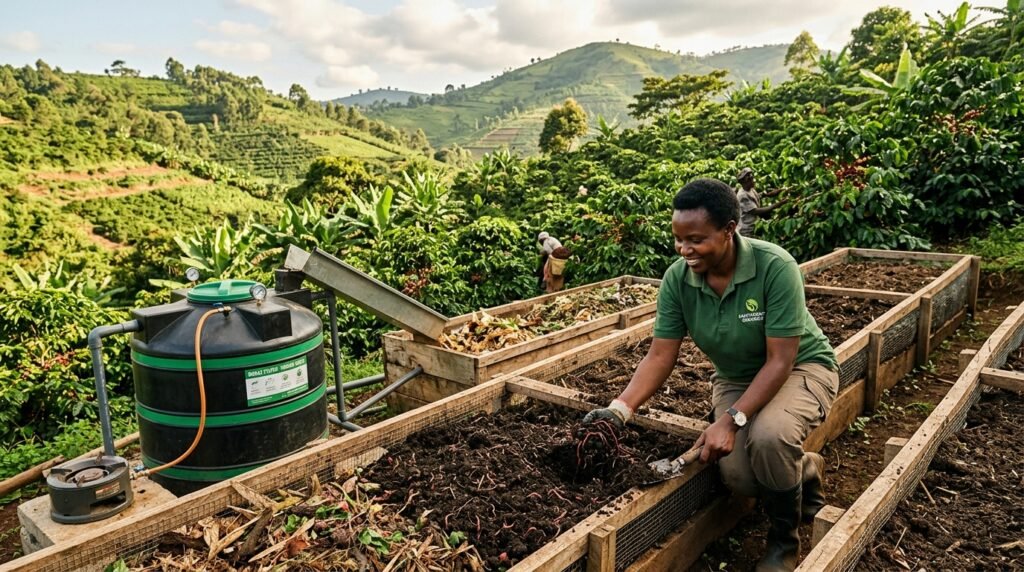
Across our 385-acre estate in Kyantamba Village, Western Uganda, agricultural waste does not exist. Every byproduct of our coffee, apiary, and tropical fruit harvests is captured and re-circulated through a self-sustaining bio-economy anchored in closed-loop anaerobic biodigesters and high-density vermiculture beds.
Reclaiming the Coffee Harvest Cycle
Conventional coffee milling is notoriously resource-intensive. During wet processing and pulping, roughly 40% to 50% of the coffee cherry’s fresh weight—consisting of the outer exocarp, sweet pectin-rich mucilage, and wastewater—is conventionally dumped into municipal waterways or left to rot in stagnant pits. This unchecked disposal causes methane emissions, acidifies local watersheds, and squanders immense botanical nutrition.
At Ntamba Processors, our post-harvest engineering captures 100% of wet-mill effluents and pulp immediately upon separation. Instead of discarding this nutrient-dense biomass, it serves as the primary organic fuel for our on-site subterranean anaerobic biodigestion infrastructure.
Clean Biogas: Thermal Energy Without Deforestation
Our commercial biodigestion chambers maintain precise anaerobic conditions where methanogenic bacteria break down the volatile fatty acids and carbohydrates in the coffee mucilage. This biological digestion produces clean, renewable biogas composed of approximately 65% methane and 35% carbon dioxide.
By piping this clean combustible gas directly into farm kitchens and auxiliary heating stations across the Kyantamba estate, Ntamba Processors completely offsets the need for firewood and charcoal. In an equatorial region where household energy demands historically fueled rural deforestation, our biogas plant permanently protects indigenous canopy trees like Cordia africana and Ficus natalensis that shelter our coffee groves.
Industrial Vermicomposting: The Power of Eudrilus Eugeniae
The solid effluent and slurry discharged from the biodigesters undergo secondary aerated stabilization before entering our dedicated vermiculture shelters. Here, over two million African Nightcrawler earthworms (Eudrilus eugeniae) process the pre-digested coffee pulp and botanical residues into rich, black humic castings.
This biological transformation delivers significant agronomic advantages over conventional chemical fertilizers:
- Humic Acid & Bio-available Nitrogen: Vermicompost stabilizes organic nitrogen into slow-release nitrates, preventing nutrient leaching during torrential Southwestern Ugandan rainy seasons.
- Microbial Inoculation: Earthworm castings harbor robust colonies of mycorrhizal fungi and beneficial bacteria that suppress pathogenic root-rot fungi in the rhizosphere.
- Moisture Retention Capacity: The sponge-like humic structure of vermicompost enhances soil water-holding capacity by up to 30%, insulating coffee root zones during dry season stress.
Liquid Bio-Fertilizer (Vermi-Tea) Foliar Feeding
In addition to solid castings, Ntamba Processors operates continuous aerobic tea brewers. By steeping mature vermicompost in oxygenated spring water enriched with natural molasses from our fruit processing lines, we extract concentrated “vermi-tea.” This nutrient-rich foliar spray is applied across our 120,000+ shade-grown Fine Robusta trees and intercropped fruit trees, providing immediate micronutrient uptake through stomatal pores while coating leaves with protective epiphytic microflora.
The Circular Economics of Regenerative Agriculture
By closing the nutrient loop on-site, Ntamba Processors eliminates chemical fertilizer and pesticide expenditures across our entire 385-acre acreage. More importantly, these circular regenerative techniques directly elevate cup quality: soils enriched with biological humic complexes yield denser coffee cherries with higher sugar brix scores, laying the scientific groundwork for our 84+ specialty Fine Robusta cupping reviews.