
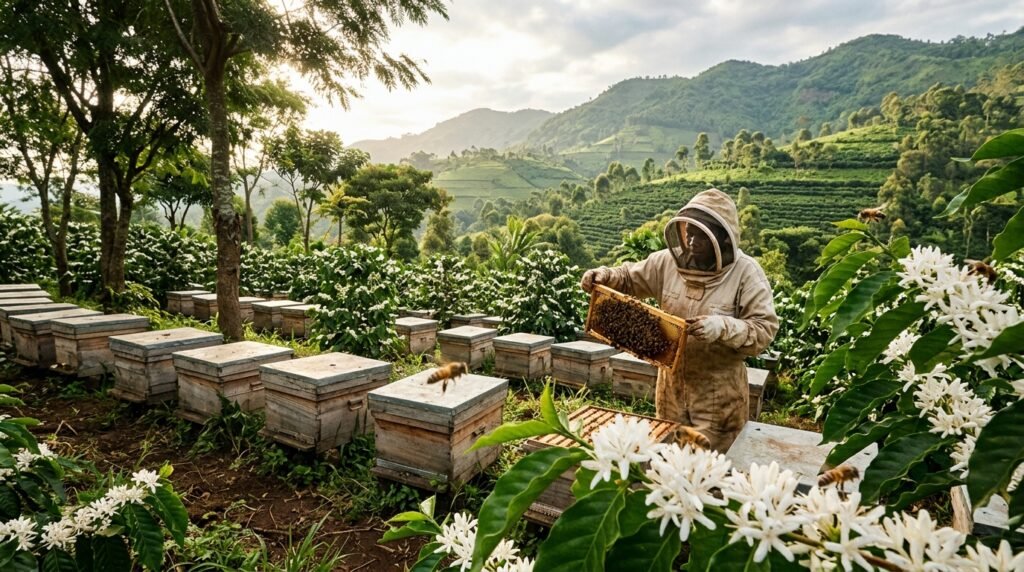
Unlike Arabica coffee, which is largely self-pollinating, highland Fine Robusta is an obligate cross-pollinator. Across the 385 acres of Kyantamba Estate, our 150+ colonised beehives are not merely a standalone honey enterprise—they are the vital biological engine behind our superior coffee cherry yields, uniform bean sizing, and complex cup flavor profiles.
The Botanical Biology of Coffea Canephora Pollination
Botanically, Coffea canephora possesses a physiological self-incompatibility mechanism. When white coffee jasmine blossoms burst open across the estate following the first equatorial rains, their stigmas require rapid, cross-compatible pollen transfer from distinct genetic trees within a fleeting 48-to-72-hour flowering window before the petals wither and drop.
Wind pollination accounts for only a minor fraction of effective fertilization. Without aggressive, high-density insect pollinator activity, thousands of unpollinated flower nodes abort prematurely, leading to empty “starved” branches and low berry set.
How 150 Apiary Colonies Transform Cherry Density
By stationing over 150 modernized Kenya Top Bar (KTB) and Langstroth beehives strategically throughout our shade-tree canopy corridors, our resident African honeybees (Apis mellifera adansonii) achieve extraordinary pollination density:
- 25% to 32% Increase in Fruit Set: Rigorous field monitoring demonstrates that coffee branches within 300 meters of apiary zones exhibit an average 28% increase in mature cherry clusters compared to isolated plots.
- Reduction in Peaberry Asymmetry: Double-ovule fertilization rates rise dramatically, ensuring that both locules in the cherry develop symmetrical, fully rounded Screen 18 beans rather than misshapen or underdeveloped single seeds.
- Synchronized Ripening: High-frequency pollination ensures that flowering occurs within tight time windows, resulting in uniform cherry ripening and facilitating selective, cherry-by-cherry hand harvesting.
Chemical-Free Sanctuary: Protecting Pollinators to Protect Crops
The presence of our sensitive honeybee colonies dictates our strict non-negotiable rejection of synthetic chemical pesticides, herbicides, and systemic neonicotinoids across Kyantamba Estate. Any application of conventional agrochemicals would devastate honeybee colonies within hours.
Instead, our agronomists utilize natural biological pest controls: neem-oil botanicals, micro-habitat corridors that shelter predatory wasps, and indigenous bird nesting sites. In protecting our bees, we naturally preserve our living soils and ensure that our green coffee beans carry zero chemical residues.
The Golden Harvest: Rare Coffee-Blossom Raw Honey
The biological symbiosis works in both directions. In exchange for pollinating our Robusta blossoms and shade-canopy trees (such as Grevillea robusta and Maesopsis eminii), our honeybees collect pure, pesticide-free nectar.
During post-flowering extractions, Ntamba Processors bottles this rare multi-floral forest honey raw and unfiltered. Rich in natural floral pollen, antimicrobial propolis, and subtle hints of warm jasmine and molasses, our raw honey represents the direct taste of agroecological balance at Kyantamba Estate.