
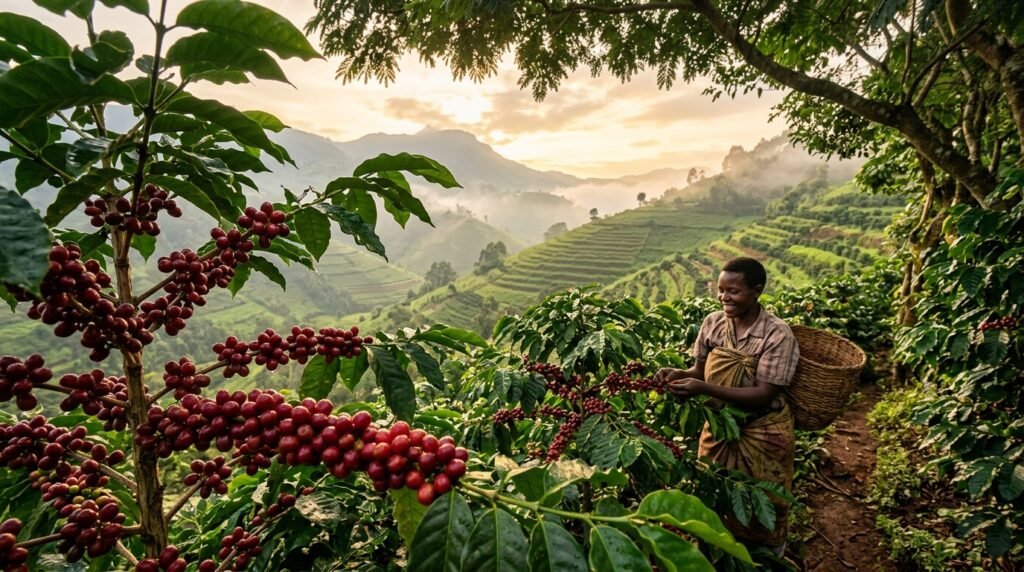
For decades, global specialty coffee orthodoxy dismissed Robusta as an inferior commodity bean suited only for instant powder or dark-roast crema filler. In the volcanic high-altitude microclimates of Kyantamba Village, Ntamba Processors is rewriting that narrative—producing single-origin Fine Robusta micro-lots that consistently score 84 to 86.5 points under rigorous Coffee Quality Institute (CQI) cupping standards.
The Evolution of the CQI Fine Robusta Standard
Just as the Specialty Coffee Association (SCA) created a formalized grading system for specialty Arabica (demanding scores of 80 points or higher), the Coffee Quality Institute (CQI) established the global Fine Robusta protocol.
Under CQI Fine Robusta standards, coffees are evaluated blindly across ten standardized sensory categories: Fragrance/Aroma, Flavor, Aftertaste, Salt/Acid Balance, Bitter/Sweet Balance, Mouthfeel/Body, Uniformity, Clean Cup, Balance, and Overall Impression. A coffee must achieve zero primary defects and score at least 80.0 points to be certified “Fine Robusta.”
Terroir at Altitude: 1,420m to 1,560m ASL
Historically, Robusta was planted in humid, low-elevation coastal plains (0m – 600m ASL), where rapid accelerated growth produced harsh, rubbery, and highly bitter chlorogenic acid profiles.
Kyantamba Estate operates at a dramatic altitude of 1,420 to 1,560 meters above sea level—an elevation typical of high-grade specialty Arabica in Central America or Colombia. At this elevation, cool equatorial nights cause tree metabolism to decelerate:
- Extended Maturation: Cherries take up to 9 to 11 months to mature, accumulating dense structural cellular density and complex sucrose precursors.
- Mineral-Rich Volcanic Terroir: Deep volcanic basalt soils in Southwestern Uganda provide rich deposits of potassium, magnesium, and phosphorus, translating into deep chocolate and stone-fruit notes in the cup.
Selective Brix Harvesting and Anaerobic Natural Processing
Achieving 84+ cupping scores requires obsessive post-harvest discipline. Our harvesting teams use optical refractometers in the field, picking exclusively when cherry sugar content reaches 21° to 24° Brix:
- Water Flotation & Density Sorting: Freshly harvested cherries undergo hydraulic flotation to remove low-density floaters.
- Controlled Anaerobic Fermentation: Selected micro-lots are sealed in airtight, food-grade fermentation barrels with one-way gas release valves for 48 to 72 hours, allowing indigenous yeasts to unlock complex esters of dried fig, tamarind, and ripe blackberry.
- Slow Sun-Drying on Raised Beds: Cherries are moved onto ventilated African drying beds under 50% shade netting. Regularly turned every 45 minutes for 18 to 22 days, parchment slowly reaches the ideal 11.2% moisture level without heat shock or re-wetting damage.
The Sensory Profile of Ntamba Fine Robusta
When cupped by certified Q-graders, Ntamba Fine Robusta shatters all lingering stereotypes of harsh bitterness:
- Aroma: Dark cacao nibs, roasted hazelnut, toasted walnut, and sweet warm panela.
- Palate: Dominant notes of dark Belgian chocolate, sun-dried mission fig, sweet molasses, and mild blackcurrant acidity.
- Mouthfeel: Immensely heavy, syrupy, coating body with an opulent, golden-brown crema that persists for minutes in espresso extraction.
- Finish: Clean, sweet, and lingering with zero rubbery astringency.
With nearly double the natural antioxidants and soluble solids of commercial Arabica, Ntamba Fine Robusta is pioneering a new era of single-origin luxury coffee for specialty roasteries worldwide.