
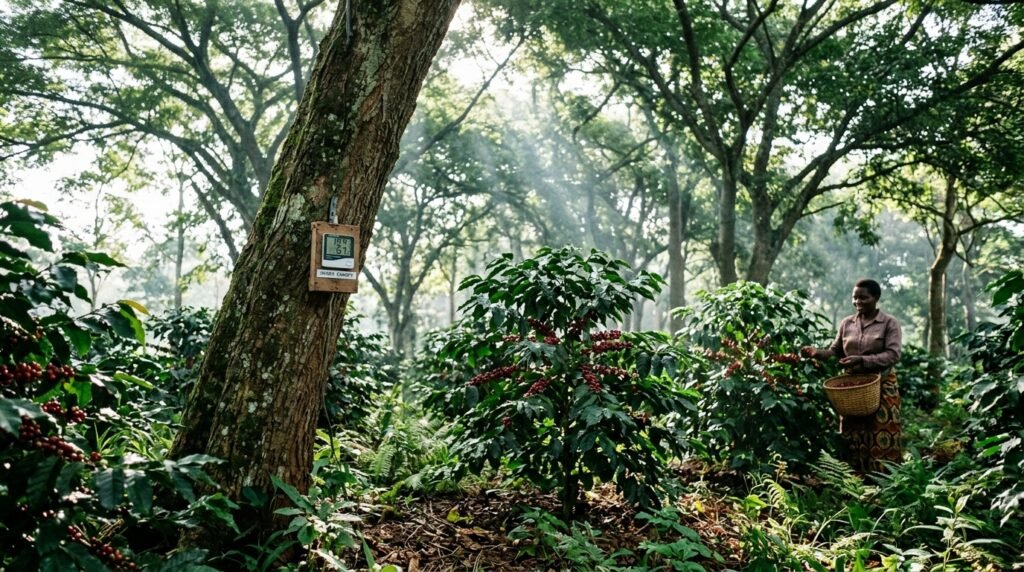
Equatorial coffee farming in the 21st century faces a severe adversary: climate volatility. Across our 385-acre Kyantamba Estate in Southwestern Uganda, we combat shifting weather patterns through deliberate multi-strata agroforestry—creating an engineered microclimate that buffers coffee trees from scorching heatwaves, conserves moisture, and fosters slow cherry maturation.
The Pitfalls of Open-Sun Monoculture
During the mid-to-late 20th century, commercial agricultural agronomy heavily promoted full-sun coffee monocultures. While full-sun systems can briefly boost initial yields under heavy synthetic fertilizer applications, they expose crops directly to equatorial extremes.
In high-altitude tropical environments like Mbarara (1,420m to 1,560m ASL), unshaded coffee trees experience intense midday solar radiation, driving leaf temperatures above 34°C. At these extreme temperatures, the photosynthetic machinery of the coffee plant shuts down through photo-inhibition. Severe leaf scorch, moisture depletion, and violent soil erosion during tropical deluges rapidly degrade farm viability.
The Multi-Tier Canopy Architecture at Kyantamba
Rather than bare monoculture, Ntamba Processors designed a complex three-tier biological canopy architecture spanning over 120,000 cultivated trees:
- Upper Overstory Canopy (18m – 25m): Dominant indigenous deep-rooting species such as Albizia coriaria, Cordia africana, and Ficus natalensis form an overarching protective umbrella. Their high, feathered foliage filters harsh sunlight into gentle, dappled irradiance without competing with coffee roots for surface moisture.
- Mid-Story Productive Canopy (6m – 12m): Intercropped shade species including nitrogen-fixing legumes, avocado (Persea americana), and indigenous bananas (Musa spp.) that generate secondary food crops and continuous mulch.
- Understory Shrub Layer (2m – 3.5m): Our primary Fine Robusta (Coffea canephora) trees thrive in this sheltered microclimate, protected from hail damage and thermal shock.
Thermal Buffering and Soil Moisture Conservation
Microclimate telemetry data collected across our estate confirms the tangible scientific benefits of our agroforestry canopy:
- 3.5°C to 5.2°C Ambient Cooling: During peak afternoon heat, ambient air temperatures beneath the Kyantamba canopy are up to 5°C cooler than adjacent unshaded open pastures, allowing continuous carbon assimilation and photosynthesis throughout the day.
- 35% Reduction in Soil Evapotranspiration: The protective shade canopy drastically diminishes surface soil evaporation, preserving precious groundwater reserves during extended dry spells.
- Organic Leaf Litter Mulch: The natural seasonal leaf drop from Albizia and Cordia trees continuously covers the volcanic soil in a thick layer of organic biomass, suppressing weed emergence and feeding soil microbes.
Slow Maturation and Specialty Cup Density
The microclimate created by our shade canopies directly impacts the sensory excellence of Ntamba Coffee. Lower average temperatures extend the fruit development period by an additional 18 to 25 days.
This prolonged maturation period allows the coffee cherry to synthesize higher concentrations of complex sugars, chlorogenic acids, and volatile aromatic compounds. When roasted, our Fine Robusta delivers a velvety, rich body, natural hints of dark chocolate, hazelnut, and dried figs—proving that ecological conservation and gourmet cup quality are intrinsically linked.